
In the first year of the current Trump administration, deportations in the U.S. increased fivefold. Arrests by Immigration and Customs Enforcement (ICE) — the agency tasked with arresting, detaining and deporting noncitizens in the U.S. — quadrupled compared to the last six months of the Biden administration. Street arrests — apprehensions that happen in neighborhoods, at immigration courts and ICE field office check-ins — multiplied by 11.
Despite claims to the contrary, these tactics often targeted those without criminal records: Non-offenders were eight times more likely to be seized by ICE after January 2025 than they were at the end of the Biden presidency. The drastic increases paint a clear — and brutal — picture of a new U.S. immigration regime.
All of these data and analyses come from one reliable source. As America is transformed in real time, with talking heads and online commentators filling cable airwaves and YouTube channels with their own versions of the truth, only one authority is providing detailed, clear-eyed and comprehensive data on each apprehension and expulsion occurring under current immigration policy: the Deportation Data Project (DDP) at UCLA and UC Berkeley.
This potent partnership, launched in fall 2024, combines the efforts of several UCLA and Berkeley social scientists and lawyers. The project is led by co-director Graeme Blair, professor of political science at UCLA; fellow co-director David Hausman, of UC Berkeley; and attorney Amber Qureshi, third co-director. Blair has been studying state violence for the past 10 years and says that ICE doesn’t proactively release individual-level data on its actions. These data are, however, public information and available to anyone through Freedom of Information Act (FOIA) requests and litigation.
“There were a lot of changes proposed to the immigration enforcement system during the presidential campaign,” Blair recalls, “and we thought that it was going to be really important to have timely data about how the system was changing.” He and his colleagues were worried that an already nearly opaque Department of Homeland Security, ICE’s parent department, would become even less transparent. Which would make studying the federal government’s immigration actions effectively impossible.
The most important data that the project has obtained: a dataset of ICE arrests, containing one row per arrest, that catalogs the where, when and how of each incident. Each cold cell of the spreadsheet relays a cruel story of removal that could lead to an individual’s suffering inhumane conditions in detention, being deported or, in some cases, dying through an avoidable tragedy. The number of immigrants for whom ICE detention holds deadly consequences is ballooning. Fast.
In its most recent iteration, the UCLA Behind the Bars Data Project is tracking all deaths in ICE custody since the agency’s 2003 founding. This grim work, led by eminent prison law scholar Sharon Dolovich, picks up where the DDP leaves off. And Mapping Deportations — an educational UCLA project that syncs up the work of Professor Kelly Lytle Hernández’s Million Dollar Hoods research initiative with that of UCLA Law colleagues like Ahilan Arulanantham — has successfully mapped the more than 8 million deportations that took place in the U.S. between 1895 and 2022.
These three Bruin-led endeavors leverage data to present the fullest picture of what is happening, what has happened and perhaps what is to come for the nation’s besieged immigrant communities. UCLA experts are doing the crucial work of unearthing data that would otherwise be kept out of public view.
One of Dolovich’s mottos for the Behind the Bars Data Project is The data wants to be free. Freeing the data is exactly the public service Bruin researchers are rendering now — at a moment when the need is most profound.
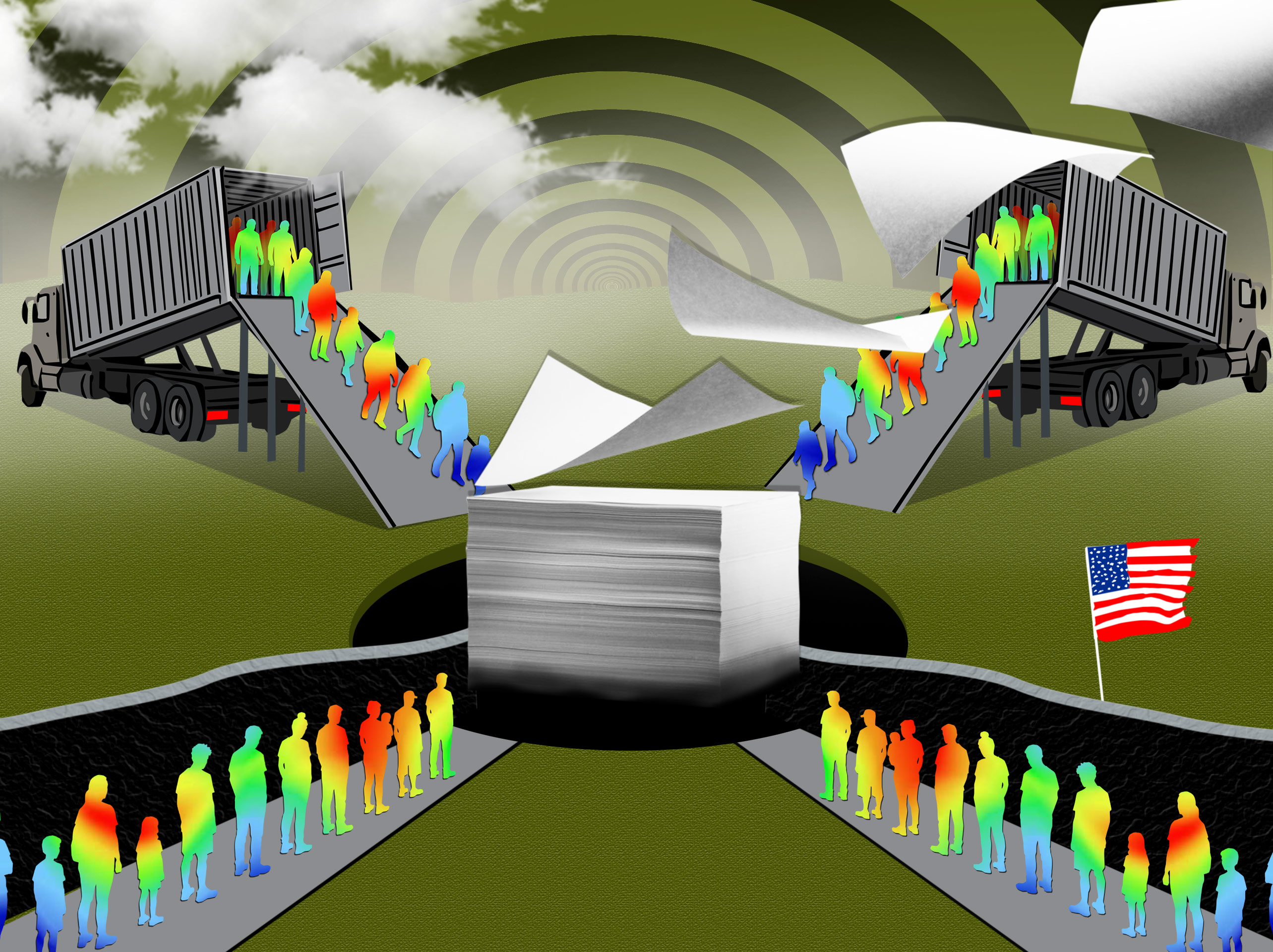
Part I. The Uncounted: Deaths in ICE Detention
Since joining the UCLA Law faculty at the turn of the century, Sharon Dolovich has pursued, with a single-minded focus, the study of incarceration. That work included founding the Behind Bars Data Project, initially to track COVID infection rates and deaths in U.S. prisons and jails at the onset of the pandemic. By February 2023, the U.S. Department of Justice had effectively stopped collecting data on all-cause deaths in custody, despite its being mandated to do so by congressional statute. As a consequence of their COVID-related efforts, Dolovich and her team held the nation’s most robust data on all-cause mortality. Thus, they expanded the program’s focus to reflect all deaths in U.S. carceral facilities.
Annette Dekker, assistant professor of emergency medicine at the David Geffen School of Medicine at UCLA, joined the team as a physician scientist in 2024. She had a deep interest in healthcare as it relates to ICE detentions. She also brought along a colleague: Independent lawyer-journalist Andrew Free had been collecting data on ICE detention deaths through FOIA requests going all the way back to the agency’s inception. In March, the first comprehensive, searchable dataset on deaths in ICE custody was published on the Behind the Bars Data website.
To Aaron Littman, the project’s deputy director, the release tells a startling story. “There has been a massive increase in the past year in the number of deaths in ICE custody,” the UCLA Law assistant professor says. Substantially more deaths were recorded in 2025 than in any of the previous 20 years; six months in, 2026 is already on track to substantially surpass that grisly record.
Play the video to see a Behind Bars Data Project map that details where deaths in ICE custody have occurred, from October 2003 to August 1, 2026:
In just the first 18 months of the second Trump administration, a staggering 53 people died in ICE custody. That’s more than a quarter of the total in the last 23 years. In January, 55-year-old Geraldo Lunas Campos was killed in a Texas detention facility. ICE claimed that Lunas Campos, a Cuban migrant being held in solitary confinement, was found attempting suicide when staff tried to save him, but a witness told the Associated Press that Lunas Campos was handcuffed, held to the ground by five guards while another put an arm around the man’s neck, and then squeezed until he lost consciousness. ICE’s initial account made no mention of any altercation with guards.
Andrew Free wrote about Emmanuel Damas, a 56-year-old Haitian man who died of an untreated tooth infection in Arizona custody in March.
Littman is quick to note that many others who may be dying as a result of immigration enforcement operations are not included in the project’s dataset. It doesn’t, for example, cover the headline-grabbing killings by immigration agents that have occurred in the street, from Alex Pretti in Minneapolis to Lorenzo Salgado Araujo in Houston. Nor does it cover people who die pre-booking or post-release — in the latter case, Littman says, “with people being potentially quite unwell and being released from custody and then dying shortly thereafter.”
Dolovich is continually frustrated that those charged with caring for detainees aren’t forthcoming about what goes on inside their facilities. “We shouldn't have to be doing as much work as we are doing to try to get public servants to tell us what’s going on in the institutions that they are running in the name of the public, and yet, that is the system that we are operating in,” she laments.
To her, the black-and-white specificity of the data is what makes it difficult for officials to claim all is well when it clearly isn’t. “When you are crowding people into facilities, and you are creating unsafe conditions and you are staffing these facilities with people who are not adequately trained, it is pretty much guaranteed that there will be needless suffering and unnecessary death,” she says. “And our data at the moment already shows that.”
Part II. Unaccountable: The Deportation Data Project
Under the Biden and previous administrations, data and statistics were posted online by ICE, Customs and Border Protection and the Office of Homeland Security Statistics. On January 21, 2025, almost every one of those dashboards went dark. The nightmare scenario Graeme Blair and his colleagues had predicted had become reality: In an instant, access to the already scant timely data being shared about immigration enforcement in the United States seemingly vanished.
The flow of information was now a trickle. Only a limited, congressionally required spreadsheet, primarily focused on ICE detentions, was posted. Related information on the total number of arrests, what kinds of people were being arrested, who was being removed from the country, and how they were being removed? Nowhere to be found.
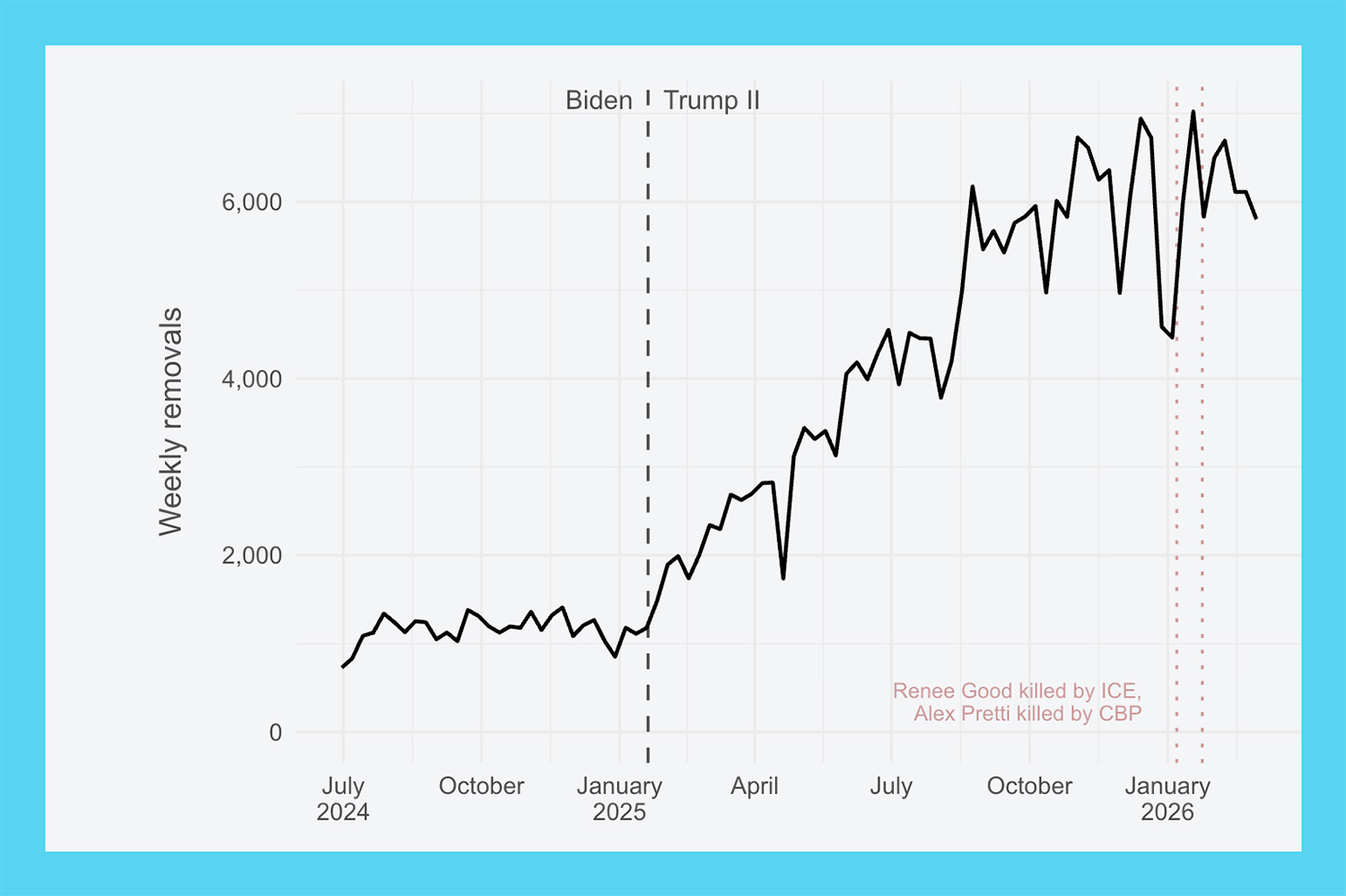
In stepped the DDP to fill the void. Its members tasked themselves with obtaining the relevant data via FOIA requests and quickly posting what they found. Blair hoped the project would allow Americans to clearly understand how their taxpayer dollars were being spent, and even more so how the coercive power of the state was being used in their name. Previously, people had typically been allowed to challenge their deportation in immigration court from outside of detention; only a very limited set of people were meant to be actually detained. The practice was not meant to be coercive.
Things are different now.
“People are seeing that what they would have to do to stay in the U.S. is to be detained under horrible conditions in detention facilities for a long time, often far from their family, because the administration has been transferring people at a higher rate to places that are really far from home,” Blair says. “The possibility is that they’re going to be removed without a substantive chance to challenge that in court.”
The DDP’s work, shining a light in the darkest corners of this new strong-arm immigration policy, has benefited countless researchers, advocates, attorneys and journalists. N. Kirkpatrick — national visual reporter at The Washington Post and part of a reporting team that won the 2024 Pulitzer Prize for national reporting on guns — is one of them. In July, Kirkpatrick and three colleagues digitally reconstructed the inside of a notoriously crowded New York City hold room for ICE detainees.
“ICE data obtained by the Deportation Data Project, alongside documents and leaked cell phone video, allowed us to illustrate what cameras were not permitted to capture: just how many people were crammed into these small holding rooms and for how long,” says Kirkpatrick. “The project was essential to our analysis, which could not have been possible using only the data ICE makes publicly available.”
Part III. Unmasking a History of Racism: Mapping Deportations
Six years ago, Kelly Lytle Hernández Ph.D. ’02, the Thomas E. Lifka Endowed Chair of History at UCLA, began giving a series of lectures that detailed the three forced migrations that, in effect, created America: the transatlantic slave trade, the removal of Native nations and mass deportation. In her lectures, she made use of a video that maps the entirety of the first of these, “Slave Trade in Two Minutes.” A University of Georgia historian’s video mapped “The Invasion of America.” A similar visual aid on deportations didn’t exist — yet.
Lytle Hernández and Mariah Tso, a cartographer colleague at Million Dollar Hoods, created a beta map of historical deportations. They then shared the map with the like-minded Ahilan Arulanantham, faculty co-director of the Miñana Family Center for Immigration Law and Policy at the UCLA School of Law. He joined UCLA in 2021, just as Lytle Hernández was delivering her lectures.
Watch the video "Who Gets Deported? 1895–2022" from Mapping Deportations:
It was an important moment, Arulanantham says, to think about the troubling role that racism has played in structuring immigration law in ways that still hugely influence the practice of the law today. Joining forces on the Mapping Deportations project made sense. The website’s videos animate, for the first time, the 8.4 million deportations that have taken place from the late 19th century through 2022. Other visuals throughout the site — timelines, charts and graphs — deliver eye-opening context.
Some of it was revelatory even for the project’s founder. “I was surprised to learn how significant anti-Blackness has consistently been to the immigration regime here in the United States,” says Lytle Hernández, whose new book Racist by Design documents the “whites-only” roots of the nation’s immigration regime. “It's traditionally been written out of the story.”
Mapping Deportations is centering that history in its storytelling. “One of the lessons that you get from Mapping Deportations is that immigration law from the very beginning really has functioned to structure the racial composition of the United States,” Arulanantham says.
While the website would be illuminating to anyone interested in the history of U.S. deportations, the principal audiences are — no surprise — litigators and educators. The project launched in October 2025, which happened to coincide with the onslaught of ICE raids. The historical parallels meant the tragic could at least be turned into the teachable.
Swipe through to see data on Black immigration to the U.S. from 1899 to 1961:
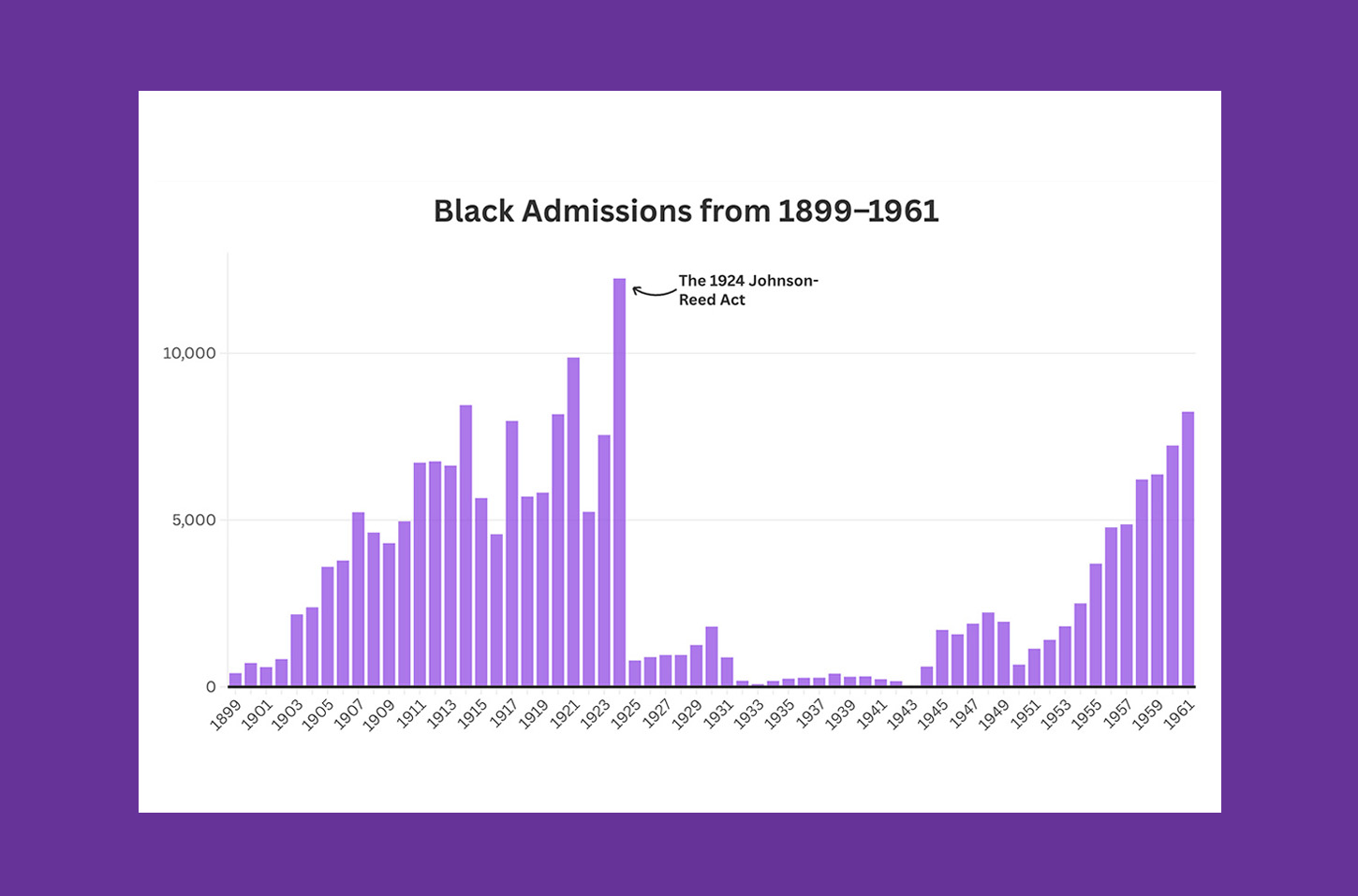
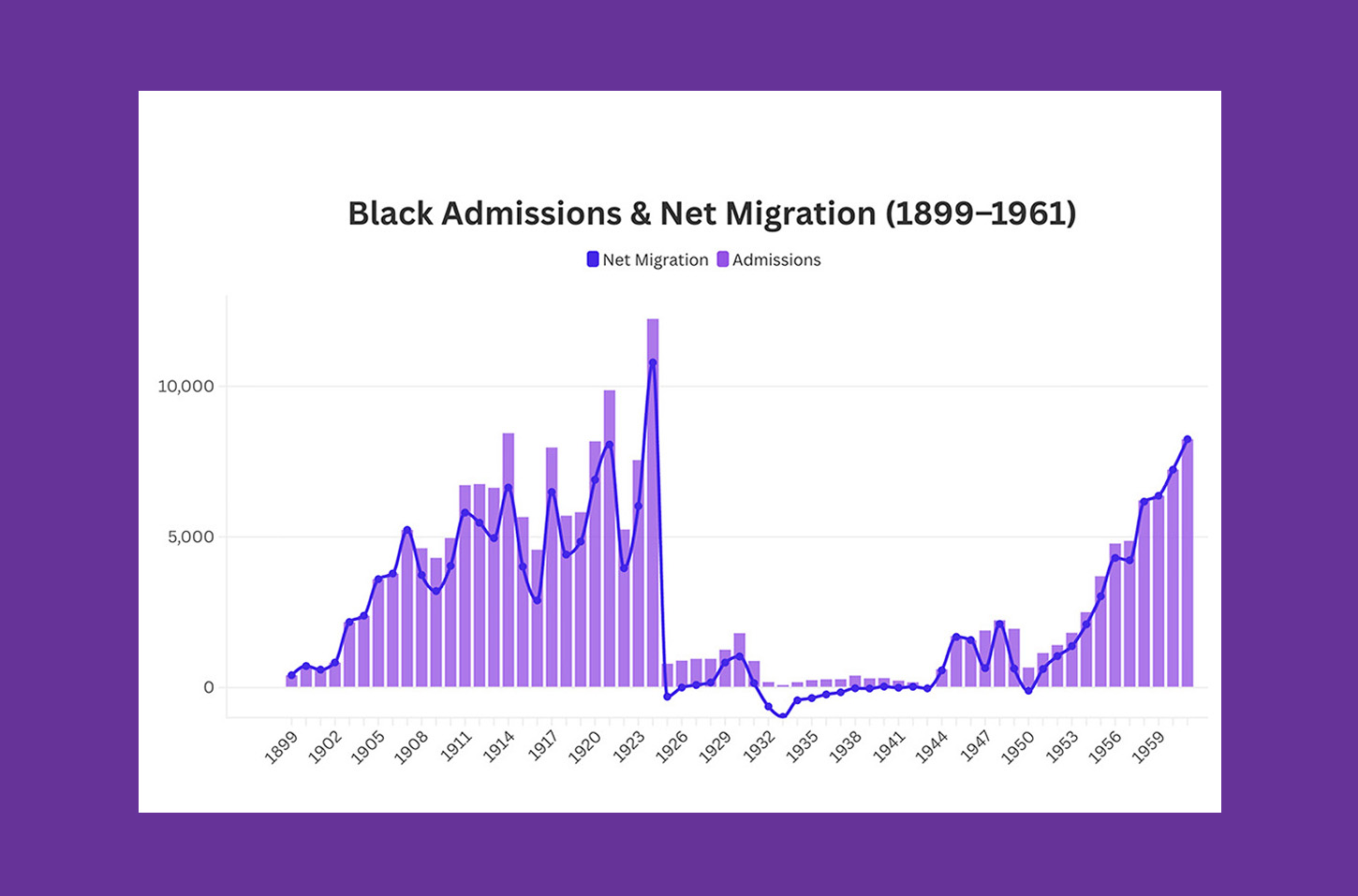
“We wanted to provide a free online resource that allowed teachers to work with their students to help them understand what was happening on the streets in front of them, or in their homes, or in their communities,” Lytle Hernández says, “or just on the news.”
For her, the issue is of both great professional and personal import. Lytle Hernández was raised in San Diego, mere miles from the Western Hemisphere’s busiest international land border crossing at Tijuana, Mexico. Two of her previous books, Migra! A History of the U.S. Border Patrol and Bad Mexicans: Race, Empire & Revolution in the Borderlands, touch on this legacy.
And while the U.S. immigration system is built on a historical bedrock of racism, notably the 1880s era of Chinese exclusion, Arulanantham points to significant moments that reversed the trend. The first is the 1965 passage of the Immigration and Nationality Act, which prohibited the racial discrimination that had previously plagued the nation’s visa allocation system.
The other landmark moment Arulanantham cites is from 1990, when Congress passed the Temporary Protected Status (TPS) law, which established the program he has spent the last decade litigating to defend and for which he argued a case, Mullin v. Doe, in the U.S. Supreme Court in April. “The Trump administration has tried to end the protections of the program because they disfavor non-white, non-European immigrants,” Arulanantham says, “and the Supreme Court has blessed that — at least thus far.” He’s talking about the conclusion of the case, which the Court ruled on in June. The decision, reached by a partisan 6-to-3 margin, grants the president virtually unlimited power to end the TPS program.
Arulanantham’s parents came to the U.S. as Sri Lankan Tamil refugees. In large part, his family background fuels his devotion to the causes of refugees and immigrants. Even in the wake of the Supreme Court setback, he remains resolute. “Our obligation in the face of lawlessness in federal decision-making,” he says, “is to continue to try to uphold the rule of law and to force the courts to do it.”
Part IV. Unflinching: UCLA’s Pivotal Role
Ananya Roy, a UCLA professor of urban planning, social welfare, and geography since 2015, bemoans this unsure, ever-changing legal environment. “In Los Angeles, this has felt as if our communities are under occupation,” says the former director of the UCLA Luskin Institute on Inequality and Democracy. “These changing rules and laws are being applied not only to those whose immigration status is up in the air, but also those who thought they had secure status — green card holders, folks on H-1B1 visas.”
Roy knows this world well; her partner’s family fled violence in El Salvador and sought asylum in Los Angeles in the 1980s. Women of the family journeyed on westbound buses from the east side of the city to clean Malibu mansions. They tell stories of la migra stopping and boarding those buses in search of hardworking people like them who came to this country with a simple, powerful ambition: to make a life for themselves in relative peace and safety.
Roy sees the fact that birthright citizenship is now coming into question as white nationalism taking hold through the law. In such conditions, she says, fierce legal contestation, undertaken by the likes of Arulanantham and his UCLA Law colleagues, is vitally important.
Although not a historian, Roy can’t help but notice that the history of the legal battles over the Fugitive Slave Acts of 1793 and 1850 bears an uncanny resemblance to today’s courtroom disputes. At stake are the definitions of legal personhood. And the limits of federal authority.
Lytle Hernández reminds us there has never been a period of human history when people have not been migrating. She asks, “How do we create systems to fit that fact? To fit that nature, that truth? The one we have right now isn't working.
“I would like us to rethink the role of migrants and migration in the modern world,” she continues. Ever the teacher, she leaves us with deep questions. “What does it mean to move across borders, or to be forced across borders, and what are our responsibilities to provide sanctuary and refuge as a modern multiracial democracy?”
Rubén Hernández-León, UCLA professor of sociology, has studied Mexico-U.S. migration for decades. Many immigrants — people who move with the idea of settling in the destination country — begin as migrants, says Hernández-León, who also directs UCLA’s Latin American Institute. “Their intention is to study or to travel or to work on a temporary basis,” he says. “They might change their minds, things happen to them, so they become immigrants.”
Over the course of his 25 years at UCLA, Hernández-León has watched the university become a national and global powerhouse in the study of international migration. A critical mass has developed in places like his own department of sociology as well as across campus. He rattles them off: political science, history, public health, Chicana/Chicano and Central American studies, law. He asserts that while many interesting projects related to immigration are unfolding on campus now, many others have been around for a long time. “These projects are connected to community organizations and have had an impact on the public conversation and on policy in the state of California, and also nationally and internationally.”
As UCLA scholars continue to set the data free — for other academics, advocates, reporters and community members to process, analyze and synthesize — the importance of the work rests on the fact that people, too, want to be free. And in an American democracy, what happens to those made unfree by U.S. immigration policies and practices shouldn’t be tucked away in a black box.
While the data unearthed by those on the front lines speaks volumes, many faculty members have been cautious about raising their voices. With higher education and research funding under assault, it’s no wonder that an air of reluctance now permeates their worlds. Christopher Tang, a distinguished professor emeritus in the UCLA Anderson School of Management, wrote a passionate, informative op-ed piece that was published in the Los Angeles Times in October 2024. His essay argued in favor of the value that immigrants add to the country in terms of diversity and national prosperity. What Tang hadn’t anticipated was that writing such an innocuous piece would make him the target of death threats.
And yet the brave work continues. The people involved in the UCLA enterprises described here are generating, presenting and protecting data on their websites so that people across the nation can easily access reliable information on immigration. But it’s especially relevant for those in California and Los Angeles: Almost half of the children in the state have at least one immigrant parent, and one in three Angelenos is an immigrant.
Dolovich sees the formation of UCLA data-driven projects related to immigration, detention and deportation as evidence that the university is performing one of its core duties, despite the pressure. “As a public university in a multicultural city, with many people who are citizens and many people who are non-citizens, this is an area of particular importance to UCLA in terms of the obligations we have to the community and the work that we ought to be doing,” she says. “It makes me especially proud.”
Read more from UCLA Magazine’s Fall 2026 issue.